
The salon phone problem, and what answers it
A salon phone rings at the worst possible moment by definition: your hands are in someone’s hair, you are mid-colour, and the client in the chair is watching to see whether you will abandon them to answer it.
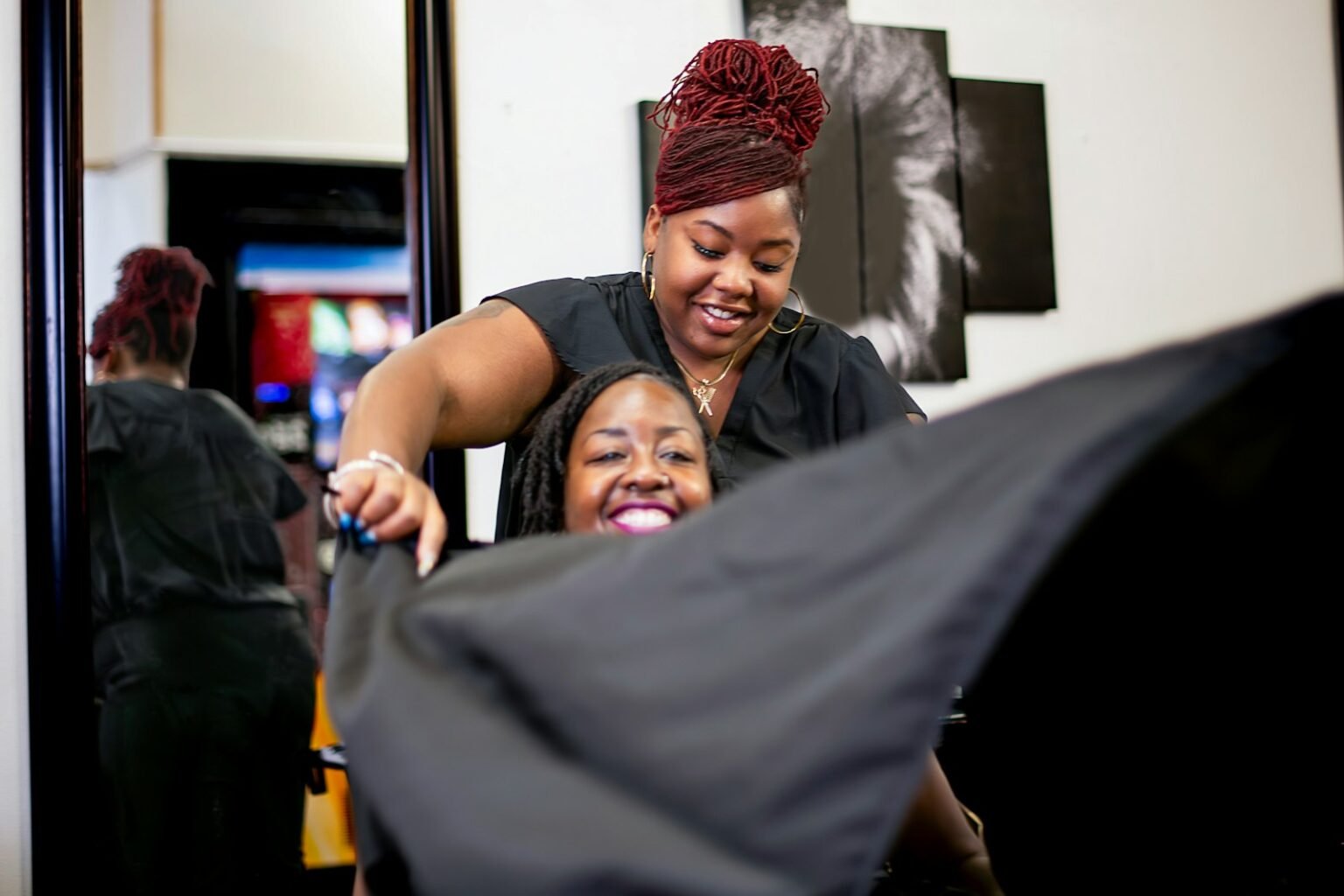
Why can a salon not simply answer the phone?
Because answering it is visibly rude to the person already paying you. Every other trade can take a call from a van or a ladder. A stylist mid-service cannot, and the client in the chair notices if you try.
So salons develop workarounds that all cost something: a receptionist the schedule cannot really justify, letting it ring and calling back between clients, or pushing everything to Instagram DMs and hoping. Each of those loses bookings, and the loss is invisible because a caller who does not get through does not appear anywhere in your records.
This is the structural difference from the field trades. An HVAC tech misses calls because they are physically elsewhere. A stylist misses calls because answering would damage the service they are currently delivering.
Licensing adds its own overhead on top: renewal cycles and continuing-education requirements vary by state, and are entirely separate from anything about how the phone gets answered. Ohio, for example, requires renewal every two years with four hours of continuing education in infection control and board rules.
The labour behind the chair is not trivial either: BLS reports about 84,200 openings a year projected for barbers, hairstylists and cosmetologists through 2034, in a role that already runs on tight, appointment-based margins.
Sources: Ohio State Cosmetology and Barber Board, Renew a License · BLS, Barbers, Hairstylists, and Cosmetologists (checked August 2026).
Why is an empty chair-hour worse than a missed job?
Because it is perishable inventory. A plumber who misses a job can often fit it in next week; the work still exists. A salon’s Tuesday 2pm does not carry forward, when 2pm passes unbooked, that capacity is gone permanently and the fixed costs of the chair were paid anyway.
Run your own numbers
Work it out for your own floor: take your average service price and your typical appointment length, and calculate what one hour of one chair earns you. Multiply by the empty hours in a normal week and by the no-shows you absorbed last month. Booth-rent and commission salons should run this differently: if you rent chairs, the loss lands on the stylist; if you run commission, it lands on you.
What does the no-show problem actually require?
A reminder that actually reaches the client, and a cancellation policy they agreed to when they booked. Neither is exotic, but both need something answering the phone that can confirm the appointment and set the reminder at the moment of booking, not a message pad.
Ansdale books into your live calendar and can send SMS confirmations, which deals with the clients who simply forget. Confirmations and reminders are the cheapest reduction in no-shows available to a salon, and they cost you nothing awkward to enforce.
Does this apply to booth renters or just salon owners?
Both, but the money moves differently. In a commission salon the owner absorbs the empty chair. Under booth rent the stylist pays rent regardless, so an unbooked hour costs the stylist directly and the owner not at all.
For context on the labour side, the Bureau of Labor Statistics reports median hourly wages of $18.73 for barbers and $16.95 for hairdressers, hairstylists and cosmetologists as of May 2024, with overall employment projected to grow about 5 percent through 2034. Those are wage medians rather than booth-rent economics, but they set the floor: an hour spent chasing callbacks is an hour not earning at the chair.
Source: U.S. Bureau of Labor Statistics, Occupational Outlook Handbook: Barbers, Hairstylists, and Cosmetologists (checked August 2026).
| Situation | What it costs | What fixes it |
|---|---|---|
| Phone rings mid-service | The call, or the client’s experience | Something else answers in your name |
| No-show, no deposit | A full chair-hour, unrecoverable | A cancellation policy stated at the time of booking |
| Client forgets appointment | Same as a no-show | SMS confirmation and reminder |
| After-hours booking request | Goes to whoever answers tomorrow first | 24/7 booking into the live calendar |
What should I read before deciding?
If you already agree the phone is the problem and want pricing and the direct comparison against a live answering service, the salon answering-service page covers that without repeating the chair-hour argument above, including what changes once every call is actually answered.
what the AI says and books · salon answering service · pricing · other trades.
What the AI says on a salon call
What does the AI say when it answers as your salon?
It answers in the salon’s name, says the call may be recorded, and says the caller is speaking with an AI assistant, before it asks anything. Both disclosures are obligations on your business, so they are built into how the system answers rather than left to a setting someone can switch off on a busy Saturday.
Why is booking a salon harder than it looks?
Because “an appointment” is not one thing. A trim is forty-five minutes. A full head of highlights with a toner and a blow-dry can be three hours and needs a processing gap in the middle that another client can sometimes be slotted into. Booking the second as if it were the first does not just run late; it collapses the rest of the day for every stylist behind it.
So the call has to establish the actual service before it offers a time. That means asking the questions a receptionist would: what the client wants done, whether they have had colour before, roughly how long since the last appointment, and whether they are coming to a particular stylist.
That last one is not a detail. Salon clients are loyal to a person, and a system that treats the salon as one shared diary will happily book a regular with the wrong stylist, which is a good way to lose a client who has been coming for years. Each stylist needs their own column, and whatever answers the phone has to respect it.
What about colour consultations and patch tests?
These are the calls where getting it wrong has consequences beyond the diary. Where your salon requires a patch test before a colour service, or a consultation before a major change, that requirement belongs on the booking call, not discovered at the chair with a client who has taken the afternoon off.
You set those rules. The AI applies them consistently: if the service requires a test a set number of hours ahead, it books the test and the appointment together, or it declines the slot and explains why.
| Caller says | What the AI does | What lands in the diary |
|---|---|---|
| “Cut and blow-dry” | Books a standard slot with the right stylist | Correctly sized appointment |
| “Full head of highlights” | Asks colour history, books the long slot | Slot with processing time allowed for |
| “First time having colour” | Applies your patch-test rule | Test plus appointment, correctly spaced |
| “Is [stylist] free Thursday?” | Checks that stylist’s own column | Regular booked with their own stylist |
What does it do about no-shows?
A three-hour colour slot lost on the morning is close to unfillable, which makes confirmations worth more in a salon than in a trade with short jobs. SMS confirmations go out on the plans that include them, and every opt-in is captured as a timestamped record rather than a verbal yes on a call, which is what the TCPA actually requires before you text a customer.
Cancellations that do come in free the slot immediately on the same diary the salon works from, so a waiting client can take it.